
JAMB Cut Off Marks for All Courses 2026: Official Minimums & University-Specific Scores
In Nigeria Over 2.2 million candidates sat for the 2026 UTME between April 16 and 25. Now the big question is: “Did I score high enough for my chosen course?”
If you’re searching for the JAMB cut off marks for all courses 2026, this guide gives you a clear, accurate answer — not guesswork. Admission in Nigeria is highly competitive, and knowing the right cut-off range can be the difference between securing admission or missing out.
This guide is built using verified updates from the Joint Admissions and Matriculation Board and recent university benchmarks. It will help you understand exactly where your score stands.
What You’ll Learn in This Guide
- Official JAMB minimum cut-off marks for 2026
- Course-by-course cut-off ranges (Medicine, Law, Engineering, Arts, and more)
- Expected cut-offs for top universities like University of Ibadan, University of Lagos, Obafemi Awolowo University, and University of Nigeria Nsukka
- How aggregate scores are calculated for admission
- Smart options if your JAMB score is below your course cut-off
By the end, you’ll know your real admission chances — and your next move.
Official JAMB Minimum Cut Off Marks for 2026
The Joint Admissions and Matriculation Board (JAMB) sets the minimum cut-off marks for all tertiary institutions in Nigeria during its annual Policy Meeting. For the 2026 admission cycle, these benchmarks define the lowest score required to be eligible for admission consideration — not guaranteed admission.
JAMB 2026 Minimum Cut-Off Marks
| Institution Type | Minimum Cut-Off Mark |
|---|---|
| Federal Universities | 140 |
| State Universities | 140 |
| Private Universities | 120 – 150 |
| Polytechnics | 100 |
| Colleges of Education | 100 |
| Colleges of Nursing | 140 |
At the 2026 Policy Meeting, JAMB approved these baseline scores while giving institutions the flexibility to set higher departmental cut-off marks based on competitiveness and available admission slots.
Important Insight
Meeting the JAMB minimum cut-off mark is only the first step. Most universities — especially competitive ones — set their actual admission cut-offs far above these benchmarks.
For example:
- A university may accept 140 officially, but
- Require 250+ for Medicine or 220+ for Engineering
This is why understanding course-specific cut-off marks is critical — which we break down in the next section.
YOU MAY LIKE TO READ:
JAMB Results 2026: How to Check UTME Scores & What to Do Next (Full Guide)
How to Pass WAEC 2026 with Past Questions and Answers PDF (Free Download)
WAEC Timetable 2026: Full SSCE Exam Schedule for May/June (Official PDF)
List of School of Nursing Currently Offering Admission Form 2026/2027 (17 Schools)
How to print police recruitment examination slip 2026
How to Check PSC Shortlisted Candidates 2026/2027 — Nigeria Police Recruitment List
How University Admission Actually Works
Most candidates misunderstand how admission decisions are made. Knowing the JAMB cut-off mark alone is not enough — universities follow a multi-step selection process that determines your real chances.
Step 1: General University Cut-Off
This is the minimum score required to be considered for admission.
- Top schools like and typically set theirs at 200+
- Many other federal universities operate within 140–180
If you don’t meet this, you won’t be considered at all.
Step 2: Departmental Cut-Off (The Real Barrier)
This is where competition truly happens.
- Each course sets its own cut-off
- Medicine & Surgery: 250 – 300+
- Law / Engineering: 220 – 280
- Less competitive courses: 140 – 180
Meeting the general cut-off does NOT guarantee admission — your course determines your real target.
Step 3: Aggregate Score Calculation
Your JAMB score alone does not secure admission. Universities combine multiple factors:
- JAMB score
- Post-UTME score
- Sometimes O’Level performance
For example, uses this formula:
Aggregate = (JAMB ÷ 8) + (Post-UTME ÷ 2)
Example:
- JAMB: 280 → 280 ÷ 8 = 35
- Post-UTME: 70 → 70 ÷ 2 = 35
- Final aggregate = 70%
This is the actual score used for admission ranking, not your raw JAMB result.
Step 4: Catchment Area & ELDS Advantage
Some universities also consider:
- Catchment states (geographical preference)
- Educationally Less Developed States (ELDS)
Candidates from these categories may gain admission with slightly lower scores.
Key Takeaway
To gain admission, you must:
- Beat the general cut-off
- Meet your departmental cut-off
- Achieve a strong aggregate score
JAMB Cut Off Marks for All Courses 2026

If you’re searching for the JAMB cut off marks for all courses in 2026, this is the most important section. These ranges are based on verified admission trends, official university benchmarks, and competitive patterns across Nigeria.
These are realistic admission ranges, not just minimum JAMB scores. Top universities like and often require scores at the upper end of these ranges.
4.1 Medical and Health Sciences (Most Competitive)
These courses consistently have the highest cut-off marks in Nigeria due to limited slots and massive demand.
| Course | Expected Cut-Off Range | Why |
|---|---|---|
| Medicine & Surgery (MBBS) | 250 – 300+ | Extremely competitive |
| Dentistry | 240 – 280 | Limited slots |
| Pharmacy | 220 – 270 | High demand |
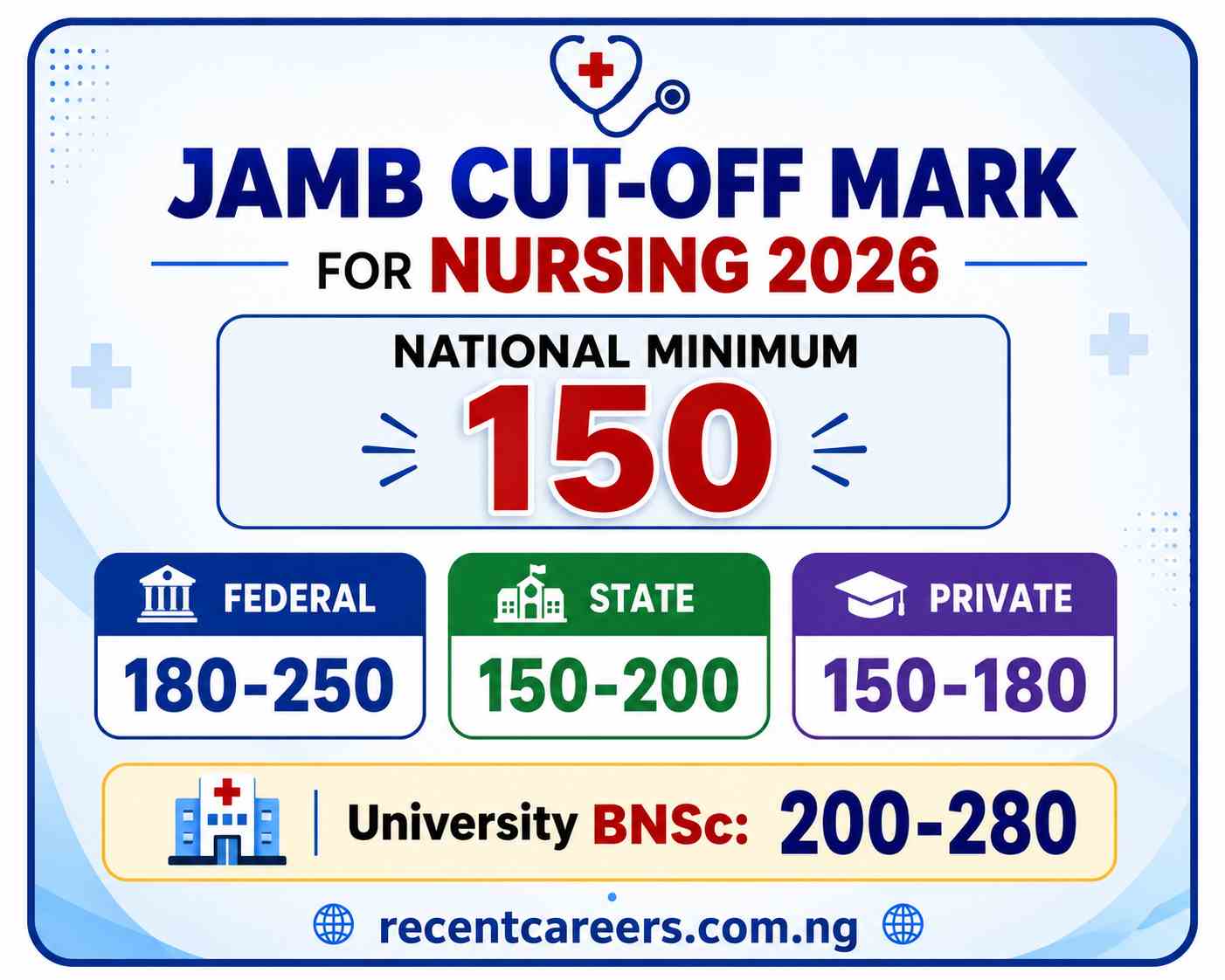
| Nursing Science | 200 – 250 | Nationwide demand |
| Medical Laboratory Science | 200 – 240 | Competitive |
| Physiotherapy | 200 – 230 | Growing field |
| Radiography | 210 – 250 | Technical course |
| Veterinary Medicine | 200 – 240 | Few universities |
| Public Health | 180 – 220 | Moderate competition |
| Biochemistry | 180 – 220 | Science foundation |
Example: The College of Nursing requires 180+ in JAMB, but top universities demand much higher.
If you score below 250, Medicine in top schools is extremely unlikely.
4.2 Engineering and Technology
Engineering remains one of the most competitive fields, especially in federal universities.
| Course | Expected Cut-Off Range |
|---|---|
| Petroleum Engineering | 230 – 270 |
| Computer Engineering | 220 – 260 |
| Electrical Engineering | 210 – 250 |
| Chemical Engineering | 210 – 250 |
| Mechanical Engineering | 200 – 240 |
| Civil Engineering | 200 – 240 |
| Biomedical Engineering | 200 – 230 |
| Agricultural Engineering | 180 – 220 |
Courses like Computer Engineering are becoming more competitive due to tech demand.
4.3 Law and Social Sciences
Law is consistently among the top 3 most competitive courses in Nigeria.
| Course | Expected Cut-Off Range |
|---|---|
| Law (LLB) | 240 – 280 |
| International Relations | 190 – 230 |
| Mass Communication | 200 – 240 |
| Economics | 200 – 240 |
| Political Science | 180 – 220 |
| Psychology | 170 – 210 |
| Sociology | 160 – 200 |
Mass Communication and Economics are now nearly as competitive as Engineering in top schools.
4.4 Pure and Applied Sciences
These courses vary widely in competitiveness depending on demand.
| Course | Expected Cut-Off Range |
|---|---|
| Computer Science | 200 – 250 |
| Microbiology | 170 – 210 |
| Biotechnology | 170 – 210 |
| Geology | 160 – 200 |
| Biochemistry | 180 – 220 |
| Industrial Chemistry | 160 – 200 |
| Physics | 160 – 200 |
| Chemistry | 160 – 200 |
| Mathematics | 150 – 190 |
| Statistics | 160 – 200 |
Computer Science now rivals Engineering due to digital career opportunities.
4.5 Commercial and Management Courses
These are popular among commercial students and moderately competitive.
| Course | Expected Cut-Off Range |
|---|---|
| Accounting | 180 – 220 |
| Business Administration | 180 – 220 |
| Banking & Finance | 170 – 210 |
| Marketing | 160 – 200 |
Insight:
Accounting remains the most competitive business course.
4.6 Arts and Humanities
These courses generally have lower cut-off marks, making them more accessible.
| Course | Expected Cut-Off Range |
|---|---|
| English Language | 150 – 190 |
| Theatre Arts | 160 – 200 |
| Linguistics | 150 – 190 |
| History | 140 – 180 |
| Philosophy | 140 – 170 |
| Religious Studies | 140 – 170 |
Good Option:
Ideal for candidates scoring 140–180.
4.7 Education Courses
Education courses are less competitive but offer strong career stability.
| Course | Expected Cut-Off Range |
|---|---|
| Education & Computer Science | 150 – 190 |
| Education & Mathematics | 150 – 190 |
| Education & Biology | 160 – 200 |
| Education & English | 140 – 180 |
Strategy Tip:
Great backup option if your score is below competitive thresholds.
4.8 Agriculture and Environmental Sciences
These courses are often overlooked but offer high admission chances.
| Course | Expected Cut-Off Range |
|---|---|
| Architecture | 200 – 240 |
| Quantity Surveying | 160 – 190 |
| Agriculture | 140 – 180 |
| Animal Science | 140 – 180 |
Lower competition = higher admission probability.
Final Insight: How to Use These Cut-Offs
- If your score is within the lower range, target state or private universities
- If your score is mid-range, aim for less competitive courses in federal universities
- If your score is high (250+), you can compete for top courses
The smartest candidates don’t just chase popular courses — they match their score with realistic admission chances.
Top Nigerian Universities — Specific Cut-Off Marks (2026)
Understanding general JAMB cut-off marks is not enough. Top universities in Nigeria set much higher admission thresholds, especially for competitive courses. Below is a breakdown of realistic cut-off expectations for leading institutions based on verified admission patterns.
(UI) — General Cut-Off: 200
UI operates a merit-based aggregate system that combines JAMB and Post-UTME scores. This makes it one of the most competitive universities in Nigeria.
Admission Formula:
Aggregate = (JAMB ÷ 8) + (Post-UTME ÷ 2)
| Course | Merit Score (Aggregate) | Estimated JAMB Equivalent |
|---|---|---|
| Medicine & Surgery | 78.875% | 290+ |
| Nursing Science | 71.375% | 280+ |
| Law | 70.875% | 270+ |
| Pharmacy | 69.125% | 260+ |
| Computer Science | 63.5% | 240+ |
| Electrical Engineering | 70% | 260+ |
| Mechanical Engineering | 70.5% | 260+ |
At UI, a high JAMB score alone is not enough — your Post-UTME performance is equally critical in determining your final aggregate.
(UNILAG) — General Cut-Off: 200
UNILAG is one of the most sought-after universities, and its competitive courses require very high JAMB scores.
| Course | Expected Cut-Off |
|---|---|
| Medicine & Surgery | 280+ |
| Law | 250+ |
| Pharmacy | 260+ |
| Engineering | 230+ |
| Accounting | 200+ |
Even though the official minimum is 200, most competitive courses require well above 230.
(OAU)
OAU maintains high academic standards with competitive admission benchmarks across major courses.
| Course | Expected Cut-Off |
|---|---|
| Medicine & Surgery | 260+ |
| Law | 240+ |
| Engineering | 220+ |
OAU tends to have slightly lower cut-offs than UI and UNILAG, but competition remains strong for top courses.
(UNN)
UNN is another top federal university with competitive departmental cut-offs.
| Course | Expected Cut-Off |
|---|---|
| Medicine & Surgery | 250+ |
| Law | 240+ |
| Engineering | 200+ |
UNN offers relatively more flexible cut-offs for Engineering, but Medicine and Law remain highly competitive.
Final Insight
Across these top universities:
- Medicine consistently requires 250–300+
- Law ranges from 240–270+
- Engineering typically falls between 200–260+
Choosing a university without considering its departmental competitiveness is one of the biggest mistakes candidates make. Always match your JAMB score with the realistic cut-off range for your chosen institution.
College of Nursing Cut-Off Marks 2026
For candidates interested in nursing and health-related programmes, Colleges of Nursing and Health Technology offer alternative pathways with clearly defined cut-off marks. These institutions often have more accessible entry requirements compared to universities, while still maintaining strong professional training standards.
Nasarawa State College of Health Science and Technology — Official Cut-Offs
Below are the approved JAMB cut-off marks for major ND programmes:
| Programme | Official Cut-Off Mark |
|---|---|
| Community Health | 150 |
| Public Health | 150 |
| Medical X-ray (Radiography) | 150 |
| Environmental Health | 130 |
| Health Information Management | 120 |
| Epidemiology | 120 |
| Nutrition and Dietetics | 120 |
| Biomedical Engineering | 120 |
| Dispensing Opticianry | 120 |
Many programmes accept scores as low as 120–150, making them a strong option for candidates who did not meet university cut-offs.
University of Ilorin Teaching Hospital College of Nursing Sciences — Basic Nursing
| Programme | Official Cut-Off Mark |
|---|---|
| Basic Nursing | 180 |
While Colleges of Health Technology may accept lower scores, Nursing programmes remain competitive, often requiring 180 or higher.
Final Insight
If your JAMB score is below competitive university thresholds:
- Colleges of Nursing and Health Technology provide realistic admission opportunities
- You can still pursue a healthcare career pathway without waiting another year
Choosing this route can be a strategic step toward long-term medical and health-related careers.
What to Do If Your Score Is Below Your Course Cut-Off
Scoring below your desired course cut-off can feel discouraging, but it does not mean the end of your admission chances. Many successful candidates adjust their strategy and still secure admission within the same year.
Here are practical, proven options to consider:
| Option | How It Works | When to Use |
|---|---|---|
| Change your course | Use the to switch to a less competitive course | Your score meets university minimum but not departmental cut-off |
| Change your institution | Transfer to a state or private university with lower cut-offs | Your score is too low for top federal universities |
| Consider polytechnics | Apply for ND programmes with cut-offs around 100–150 | You prefer a practical or technical career path |
| Consider Colleges of Education | Enroll in teaching programmes with cut-offs of 100–140 | You are open to an education career |
| Consider private universities | Apply to institutions with flexible cut-offs (120–150) | You can afford higher tuition fees |
| Retake JAMB next year | Prepare strategically and aim for a higher score | Your score is far below your target course |
A score of 140 or 150 still opens doors. There are many universities and programmes in Nigeria that accept these scores, especially outside highly competitive courses like Medicine, Law, and Engineering.
The smartest approach is to match your current score with realistic options, rather than waiting without a plan. Many candidates who quickly adjust their choices often gain admission faster than those who do not take action.
Frequently Asked Questions (JAMB Cut-Off Marks 2026)
Below are clear, direct answers to the most searched questions about the JAMB cut off marks for all courses in 2026. These are based on official benchmarks, university data, and verified admission trends.
What is the official JAMB cut off marks for 2026?
The approved 140 for federal and state universities and 100 for polytechnics and Colleges of Education. These are minimum eligibility scores, not guaranteed admission thresholds.
What JAMB score is needed for Medicine?
Medicine and Surgery typically require 250–300+, especially in top universities. Highly competitive schools may only admit candidates with scores close to 280–300.
Can I gain admission with 180?
Yes. A score of 180 can secure admission into courses like Agriculture, Education, Arts, and some Social Sciences, particularly in state universities or less competitive institutions.
What JAMB score is needed for Nursing?
Nursing generally requires 200–250 in universities. However, institutions like College of Nursing accept a minimum of 180.
Do all universities use 140 as cut-off?
No. Top universities such as and set their minimum at 200 or higher.
What is UNILAG’s cut-off mark for 2026?
The uses a general cut-off of 200, but competitive courses like Medicine, Law, and Pharmacy require significantly higher scores.
Does a high JAMB score guarantee admission?
No. Admission depends on your aggregate score, which includes JAMB, Post-UTME, and sometimes O’Level results. A high JAMB score alone is not sufficient.
What if I scored below my course cut-off?
You can use the to change your course or institution to one that matches your score.
What JAMB score is needed for Law?
Law typically requires 240–280, depending on the university and level of competition.
What JAMB score is needed for Engineering?
Engineering courses generally require 200–260, with higher scores needed for competitive fields like Petroleum or Computer Engineering.
Important Note
Always match your JAMB score with realistic course and university options. That strategy significantly increases your chances of gaining admission in 2026.
Final Tips for JAMB Candidates (2026)
After knowing the jamb cut off marks for all courses, naking the right decisions after your UTME result can significantly improve your admission chances. These final tips are based on real admission patterns and verified guidelines.
| Tip | Why It Matters |
|---|---|
| Know your departmental cut-off | General university cut-offs can be misleading; admission is based on course-specific thresholds |
| Prepare seriously for Post-UTME | A strong Post-UTME score can boost your aggregate and compensate for a lower JAMB score |
| Have a backup plan | Choosing alternative courses or universities increases your chances of admission |
| Monitor official announcements | Stay updated through your chosen university and the |
| Do not pay for “score upgrade” | JAMB scores are final and cannot be altered; such offers are scams |
Admission is not just about scoring high — it is about making informed, strategic decisions. Candidates who understand how cut-offs, aggregates, and course competitiveness work are far more likely to secure admission.
Stay informed, plan smartly, and avoid costly mistakes.


Can I study nursing with 229
Yes
May god guide us,make it to be successful